

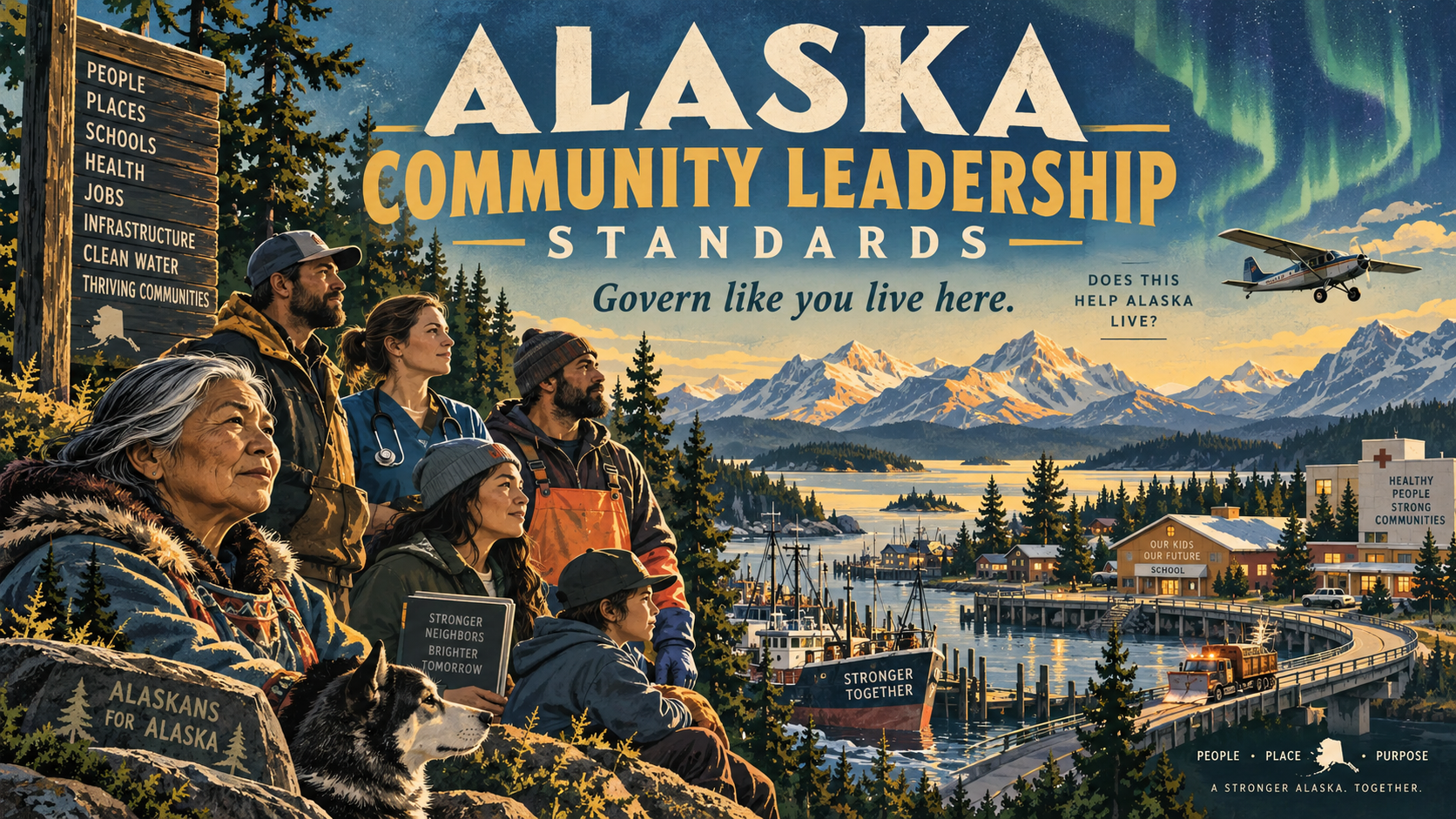
Alaska is different.
Distance matters. Weather matters. Transportation matters. Schools, clinics, harbors, airstrips, power systems, housing, food, and strong local relationships are not luxuries here. They are what make it possible for communities to survive and thrive.
The Alaska Community Leadership Standards are a practical, nonpartisan way to evaluate whether a leader, policy, budget, or public project actually strengthens Alaska.
The question underneath all of them is simple:
Does this help Alaska live?
We are less interested in political labels, campaign slogans, or who gives the best speech.
We want to know what happens on the ground.
Does the decision help people stay housed, warm, fed, connected, educated, and cared for?
Does it strengthen local communities?
Does it maintain the systems we depend on?
Does it keep more knowledge, opportunity, and wealth in Alaska?
And will it still work after the fifth winter.
The AK4AK Golden Rule
Judge leadership by what it builds.
Resilience.
Local capacity.
Household stability.
Public trust.
Communities that are alive—and worth staying for.
Does this help Alaska live?
-
Ordinary Alaskans should be better off because of the decision.
-
The people who live with the consequences should help shape the solution.
-
Roads, ferries, schools, clinics, broadband, water, energy, harbors, and airstrips need maintenance—not just ribbon cuttings.
-
Teachers, nurses, tradespeople, families, and Elders should be able to afford to stay in the communities they serve.
-
A solution that works in Seattle or Washington, D.C. may not work in Bethel, Kodiak, Utqiaġvik, or Homer.
-
Good decisions account for maintenance, replacement, changing conditions, and future generations.
-
Item Development should leave communities stronger, not simply export profits and leave the costs behind.
-
Budgets, contracts, evidence, risks, and tradeoffs should be understandable to ordinary people.
-
Tribal governments, local communities, youth, Elders, workers, and affected residents should have meaningful voices.
-
Results matter more than political theater.
-
Indigenous knowledge, rural experience, trades expertise, subsistence knowledge, and lived experience are survival intelligence.
-
Outside investment and expertise can help—but Alaska should not carry the risk while someone else controls the decisions or takes the profit.
-
Strong schools, training, housing, meaningful work, and belonging keep communities alive.
-
Libraries, local journalism, schools, arts, cultural institutions, gathering spaces, and community traditions help people remember who they are to one another.
A Simple Way to Use the Standards
When you hear about a new policy, candidate, budget, development project, school decision, or ballot measure, ask:
Who benefits?
Who carries the cost?
Were affected communities involved?
Does it strengthen or weaken the systems people rely on?
Can Alaskans maintain it ourselves?
Does it create more stability—or more dependency?
What happens five, ten, or twenty years from now?
Then look for evidence.
Not vibes.
Not party labels.
Not one heroic Facebook post.
Receipts.
For the AI savvy…
Upload the Leadership Standards Guide & Rubric to your chatbot of choice.
Ask your chatbot to do a search on the candidate or issue in question and cross-reference its findings against the Leadership Standards and assess according to the rubric.
Questions answered.